Power Plays Lab- With Exclusive Access To The
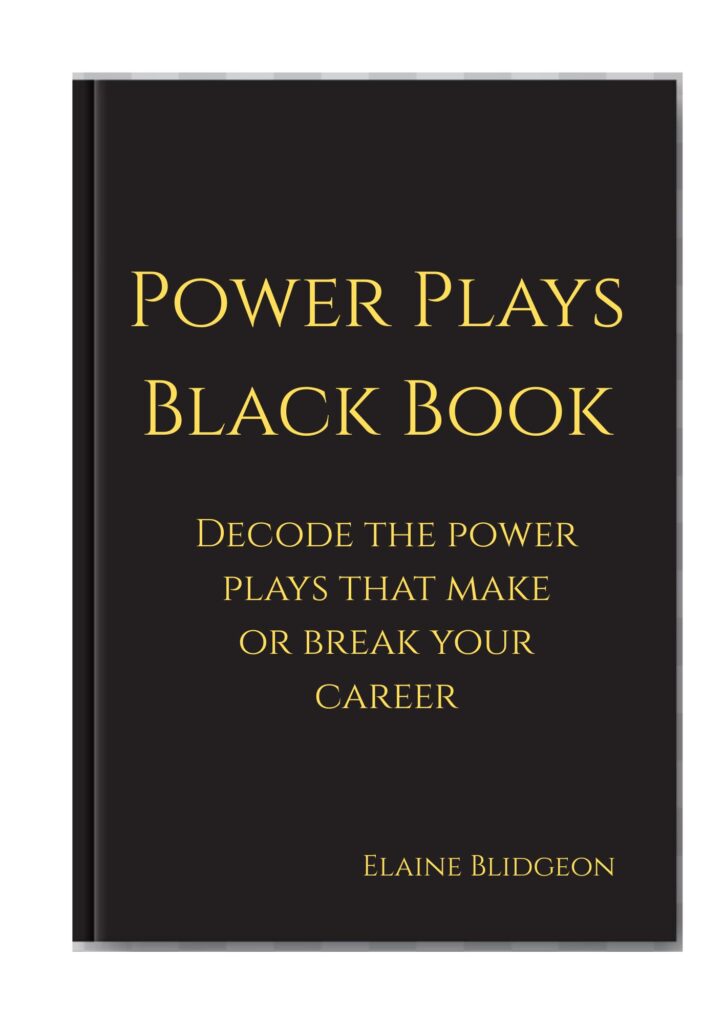
Power Plays Black Book
Power Plays Lab and the Power Plays Black Book give you the roadmap I wish I’d had when politics and power plays hit – something that tells you what’s really going on, names their moves, gives you options, protects your emotional state and proves this is a skills gap you can close, not a battle you can never win.
Now let me show you what Power Plays Lab actually is and how it works in practice.
What Is The Power Plays Lab?
Power Plays Lab is more than just a workshop – it’s your fast track to understanding human nature at work in real time, and how to communicate with people from a political standpoint that still feels like you.
In your very first session, you’ll get practical, field‑tested tools to spot power plays and hidden agendas in everyday conversations, meetings and decisions – and to see how human nature is driving them.
By the end of the programme, you won’t just notice when something feels off – you’ll know how to respond in the moment in a way that protects your reputation, relationships and opportunities, instead of being the easy target.
This isn’t theory or guesswork; it’s the same approach I’ve used and refined over years of navigating people, power and politics with clients – a proven, on‑the‑job system for professionals who are done wasting energy on drama and want skills they can use immediately.
.
Your Instructor: Elaine Blidgeon
When I say power plays, I’m talking about the subtle moves people use to get what they want at your expense – the moves most professionals feel but struggle to name.

Elaine Blidgeon is a Workplace Strategist and executive coach who specialises in people, power and politics at work. For over two decades she’s studied human behaviour, trained in NLP and belief‑change methods, and coached professionals who were blindsided, sidelined or quietly capped by office politics. If it involves decoding subtle power plays, navigating difficult personalities, or communicating strategically without becoming someone you’re not, Elaine can help you see the real game and respond with a clear, practical plan
The Moment Everything Flipped
At some point, something in me flipped. I decided to use the skills I already had – my training in human behaviour and my natural strategist’s brain – to redress that imbalance. It wasn’t that I couldn’t see what was going on; it was that I thought “rising above it” proved I was better than them. How wrong I was.
Once I understood how power and politics actually worked, and found an ethical, professional way to handle the players, I deliberately upgraded my skills. I learnt how to get backing from the people who could genuinely change things, how to make my requests heard, and how to protect my position without turning into someone I didn’t recognise.
Power, Progress and Keeping My Integrity
The result was a quiet but radical shift: my input was listened to, my standing improved, and the praise and support I’d been hoping hard work alone would earn finally started to show up.
I still wasn’t a suck‑up, I still kept the colleagues and self‑respect that mattered to me – but I was no longer the easy target. I was rising, with my integrity intact. That “before and after” is the journey Power Plays Lab and the Power Plays Black Book are built to give you a path through.
Power Plays Lab
A direct path to skills that usually take years (and a few career bruises) to develop.
Before I created Power Plays Lab and the Power Plays Black Book, I was the classic capable professional: delivering, over‑delivering – and still finding myself blocked, side‑lined or quietly capped in workplaces where the real decisions were happening somewhere else.
I spent years studying psychology, NLP, belief‑change work and “good communication” – but in real workplaces, I kept hitting the same wall: none of it properly accounted for the informal power, human nature and office politics that were actually driving outcomes.
People and power are complex, and the neat models in books didn’t always hold up in rooms where egos, history and hidden agendas were in play.
So I threw myself into the real thing – tracking hundreds of live situations from my own jobs, from clients, and from real‑world stories, mapping the power plays, testing responses, and seeing what actually protected people’s reputation, sanity and opportunities over time.
Power Plays Lab is the result: a distilled, field‑tested way to see the patterns most professionals only recognise in hindsight – and to build the skills to handle them while they’re happening, instead of after the damage is done.
What’s inside Power Plays Lab
Inside Power Plays Lab, you get:
- Live breakdown sessions – small‑group calls where we dissect real workplace scenarios (from members, anonymised client stories and curated Reddit examples) to spot the power plays, map the people, and practise safer responses in real time.
- Implementation / coaching calls – focused sessions to apply the tools to your situation, so you walk away with specific next steps, not just insight.
- The Power Plays Black Book (Level 1–5 access) – your private political‑skill toolkit with early‑warning alerts, emotional reset tools, power‑type X‑ray, workplace mapping sheets and the 7‑step Milestone Map for real career momentum.
- Quick‑use scripts and questions – simple phrases and safety checks you can use before tricky 1:1s, “be honest with me” conversations, performance reviews and meetings.
- Ongoing updates – new power plays, examples and mapping prompts added as workplaces (and your roles) evolve, so your Black Book grows with your career.
Lab opens a few times a year, and the Power Plays Black Book is only available to Lab members. If you want first access when doors open – and priority on limited small‑group spots – your next step is to join the early access list.
Power plays Black Book
The Old Way
The default way most decent people handle office politics
- Keep your head down and hope good work speaks for itself.
- Treat tricky situations as “just personalities” or “team drama”, not power plays.
- Rely on gut feeling and venting, not a clear checklist.
- Say yes to “be honest with me” or “can I pick your brain?” without checking the political risk.
- Only realise it was politics after the damage is done (reputation, promotion, relationships).
- Result: high stress, feeling blindsided, stuck or quietly capped.
The Easy Way
With Power Plays Lab + the Power Plays Black Book
- Use a simple checklist to spot when something is a power play, not “just” drama.
- Treat office politics as a learnable skill, not a dirty word.
- Run quick safety questions (Black Book prompts) before you speak in risky conversations.
- Have names and counter‑moves for the most common plays, so you respond cleanly instead of reacting.
- See patterns early enough to protect your reputation, relationships and opportunities.
- Result: lower stress, fewer nasty surprises, more quiet leverage and career options.
If you’re good at your job, sense that something in the dynamics is wrong, and still haven’t been given a clear way to see or handle this side of work, my Power Plays Black Book is exactly right for you.
What Is A Power Plays Black Book?
The Power Plays Black Book is your private political‑skill toolkit – a practical guide to the people, the power and the politics that quietly decide who gets protected, promoted and listened to at work, even if you don’t like office politics.
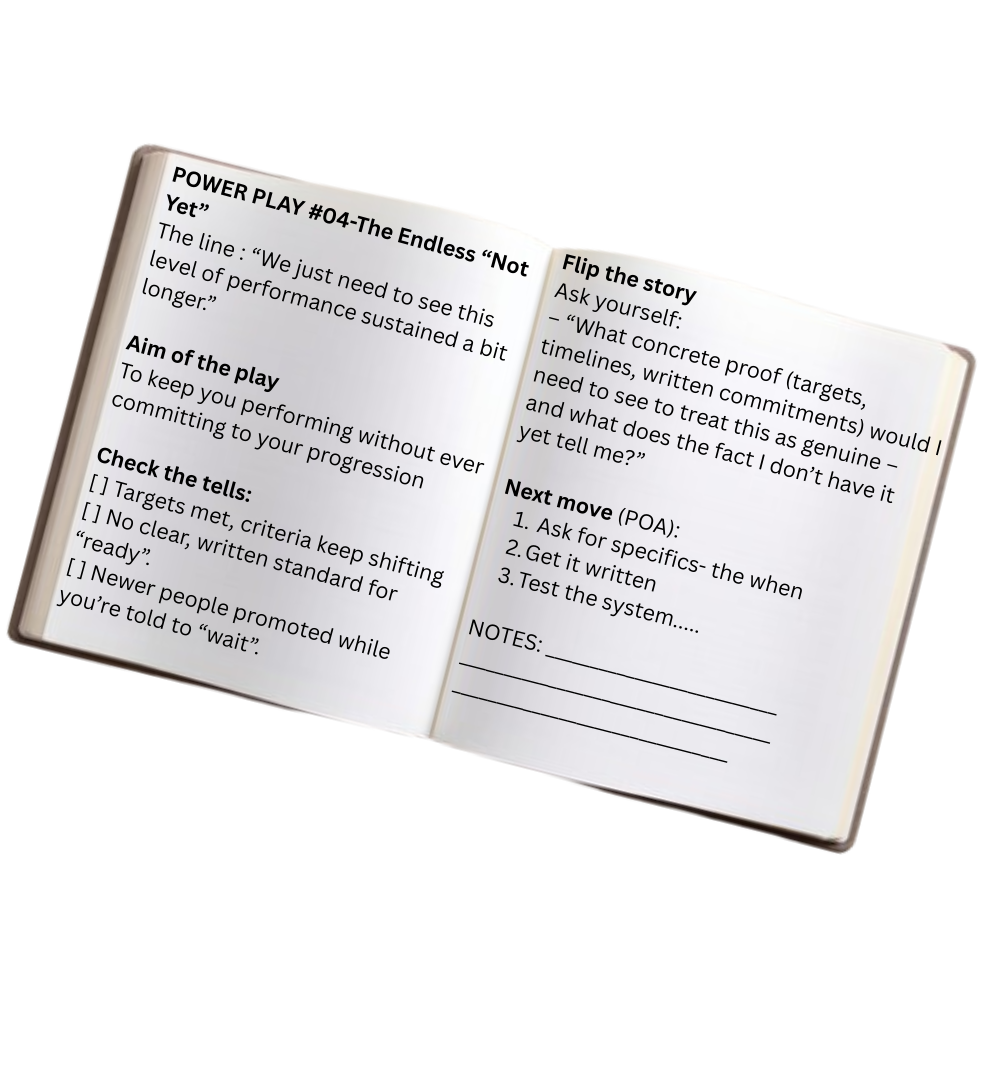
It gives you 20 early‑warning power‑play alerts so you can spot trouble before it lands on your desk, a Reframe Method that mops up the emotional sting of being played, and simple mapping tools that show you who really holds influence around you and where your own leverage is growing or leaking. Instead of learning these lessons through years of painful trial and error, you have a living reference you can open before tricky conversations, new teams or big decisions, so you can protect your reputation, make smarter career moves and stop being the easiest person to overlook.
What Office Politics Really Is (and Isn’t)
If the phrase “office politics” makes you think of backstabbing, brown‑nosing and two‑faced behaviour, you’re not alone. For years I felt the same – and many of my clients did too. The trouble is, when you see politics only as something toxic, you quietly opt out of the very skills that would have protected you.
In my world, office politics isn’t endless drama; it’s a set of high‑level interpersonal communication skills and informal power skills that quietly shape who gets heard, protected and promoted. It’s the human‑nature side of work: who actually has influence, how relationships really work, and what happens to people who don’t see that side of things.
From “Communication Problems” to Power Patterns
When I talk about political skill, or political fluency, I’m not talking about manipulation. I mean understanding how influence and relationships work where you are, so you can make smart choices, avoid unnecessary conflict and stop being the easy target. Many “communication problems” and “confidence issues” my clients bring me turn out to be deeper power and influence patterns in disguise – who has it, how they hold it, and what everyone else gives up by not seeing the pattern.
Most of us were taught that if we work hard, are reasonable and treat people well, things will work out. What rarely gets explained is that different people come with different values, motivations and hidden agendas. We often assume others see the world the way we do, and that’s exactly where we get unstuck. Office politics, as I teach it, is simply learning higher‑level people skills for dealing with that gap.
“Only leaders Need Politics” – Why That Hurts Everyone Else
There’s a quiet myth that “only senior leaders need to understand politics”. In reality, political dynamics affect every level: whose projects get approved, whose mistakes are quietly forgiven, who gets pulled into blame and who gets quietly protected. If you work with other humans, you’re already dealing with politics in the sense of differing interests, agendas and influence.
The question isn’t whether you’re involved; it’s how equipped you feel to navigate different personalities and under‑the‑surface agendas when no one has ever really taught you the rules of engagement. This is about being able to work well with others in real organisations – not about learning tricks.
Power Plays: What You’re Actually Dealing With
That’s where the idea of power plays comes in. Power plays are the moves people use to shift power, status or control at work. Some are innocent habits, some are deliberate with bad intent. Once you can spot them, you can stop them being used against you and start using the healthy, ethical ones in your favour – to protect your reputation, your relationships and your future options.
When you don’t have language for these patterns, everything feels personal and random. With language and examples, you start to see that many “mystery” problems at work are really informal power plays shaping relationships, recognition and decisions underneath what looks like “just” team or interpersonal issues.
Why Learning This Isn’t Selling Your Soul
Choosing to learn office politics skills in this way isn’t about becoming fake; it’s about upgrading your communication skills for a more complex environment. You’re learning how to read situations more accurately, ask better questions, and make smarter choices about what you say and do when you can’t see everyone’s agenda clearly.
If you’ve avoided politics because it felt dirty, that came from protecting something important in you – a sense of integrity. Power Plays Lab and the Power Plays Black Book are built to honour that: giving you practical ways to handle human nature at work, so you can stay effective, protect your career and keep your self‑respect intact.
If you’ve avoided politics because it felt dirty, that came from protecting something important in you – a sense of integrity. Power Plays Lab and the Power Plays Black Book are built to honour that: giving you practical ways to handle human nature at work, so you can stay effective, protect your career and keep your self‑respect intact.
Here’s What This Means for You…
Every project, promotion and “difficult situation” at work is built on one thing – how people, power and politics are actually working around you.
…and navigating that comes down to two skills:
spotting informal power plays early, and understanding what really drives other people’s decisions – especially when they don’t say it out loud.
But
that kind of political fluency is exactly what most decent professionals are never taught, which is why they get blindsided, over‑used or quietly capped, even when they’re doing great work.
That’s why I created Power Plays Lab and the Power Plays Black Book – to give you a practical, field‑tested way to:
✅ See the key power plays as they’re starting
✅ Read who really holds what kind of influence around you, and
✅ Respond in ways that protect your reputation and move your career forward, without spending years learning every lesson the hard way.
This is for people who care about integrity. We don’t teach tricks; we teach skills that help you stay effective and fair in imperfect systems.
Who Power Plays Lab Is For (And Not For)
Power Plays Lab is for you if:
- You do good work but still find yourself overlooked, over‑used or quietly side‑lined.
- You sense politics in decisions, promotions or projects, but can’t quite see the pattern or explain it.
- You hate the idea of “playing games”, yet you’re tired of being the one who gets blindsided or blamed.
- You replay conversations for days, wondering what you missed or said wrong.
- You want more influence and options at work, without becoming manipulative or turning into someone you don’t recognise.
Power Plays Lab is not for you if:
- You’re looking for tricks to out‑manipulate other people.
- You want a guarantee of promotion regardless of performance.
- You’re unwilling to reflect on your own patterns or try new ways of responding.
This is a space for decent, ambitious professionals who want to handle people, power and politics more intelligently – with their integrity intact.
Every Question [With Answers] I’ve Ever Been Asked About Office Politics
Q1. Will learning office politics force me to be fake or two‑faced just to get ahead?
Learning office politics here isn’t about acting fake; it’s about upgrading your interpersonal skills so you can handle real people, real agendas and real pressure without losing yourself. It gives you more honest options in tricky situations, not more masks to wear.
Q2. If I learn office politics, won’t I end up just like the people I dislike?
The people you dislike are often using political skill without conscience; you’re learning political skill with conscience. The same awareness that lets them manipulate can, in your hands, protect your reputation, your boundaries and the people you care about.
Q3. Shouldn’t good work be enough without having to ‘play politics’?
In a fair world, good work would be enough; in real organisations, good work is the entry ticket, not the whole game. Political fluency simply makes sure your good work is seen, valued and protected, instead of quietly taken for granted or used against you.
Q4. If I’m meant to get promoted, won’t it just happen naturally?
Promotions don’t happen “naturally”; they happen through people – their perceptions, relationships and decisions. Political skills help you understand how those decisions are really made, so you can line your efforts up with reality instead of crossing your fingers and hoping.
Q5. Isn’t office politics just drama I’m better off staying out of?
What looks like “just drama” on the surface is often informal power plays shaping who gets work, support or blame. Staying out of the noise is healthy; staying blind to the patterns is expensive. The Black Book teaches you to tell the difference.
Q6. I tried getting involved in office politics once and got burned – why would this be different?
Most people “get involved” in politics by accident, without language, tools or boundaries. This is the opposite: a structured way to name the plays, run quick safety checks and choose cleaner moves, so you keep your integrity and reduce the risk of being burned again.
Q7. Isn’t office politics really for loud, extroverted people – and what if that’s not me?
Loud isn’t the same as politically skilled. Some of the most effective players are quiet, observant and thoughtful – they read the room and say less, but say it better. Political fluency is about awareness and timing, not volume or personality type.
Q8. I’m a decent person and I don’t ‘play games’ – is this really for someone like me?
This is especially for people like you. The problem isn’t that you “don’t play games”; it’s that other people do, and you’re the one who pays for it. Political fluency gives decent people a fair chance in systems that already reward those who understand power.
Q9. Will I have to change who I am just to fit in if I learn this?
You stay who you are; what changes is how you handle other people. This is about upgrading your communication and boundary skills in a political environment, not swapping out your values. You’re learning more ways to be you effectively, not becoming someone else.
Q10. What if I’m bad at reading people and always miss the signals – can I still learn this?
That’s exactly who the Black Book is built for. If you already caught every signal, you wouldn’t need it. The patterns, questions and examples are there to give you a structure, so you don’t have to rely on instinct alone.
Q11. I’m too honest – can I really do all that ‘strategic’ stuff without feeling wrong?
Strategy isn’t the opposite of honesty; it’s deciding when and how to be honest in a way that doesn’t damage you. You’re not learning to lie – you’re learning to tell the truth in a way that protects your reputation and your relationships instead of sacrificing them.
Q12. If I set boundaries or say no, won’t I look difficult or disloyal?
Looking endlessly available is what quietly erodes trust and respect. Political skill helps you set boundaries in a way that signals maturity and reliability: “I care about the work and the relationship – and I also protect what lets me do a good job.”
Q13. If I learn office politics skills, won’t I just start overthinking everything?”
At first you notice more, like when you learn to drive and think about every mirror. Then it becomes second nature. The aim is less mental spin, not more – a few clear questions you can run quickly, so you stop replaying conversations at 3 a.m.
Q14. I’ve survived this long without political skills – do I really need them now?
You’ve survived without them; the question at what cost?: missed promotions, unfair workloads, being the safe pair of hands who never quite moves. Political skills are about shifting from “surviving despite the system” to “making the system work less against you.”
Q15. Doesn’t a ‘Power Plays Black Book’ sound a bit scheming – I don’t want to be sneaky.
The Black Book isn’t a manual for scheming; it’s a reference guide to patterns that are already being used around you. You’re not learning how to manipulate people – you’re learning how to recognise the moves, reduce your risk, and choose cleaner responses.
Q16. Isn’t keeping a Black Book of power plays a bit paranoid?
Paranoia is assuming bad intent everywhere; the Black Book is about recognising specific situations where risk is higher, so you can stay calm and clear‑headed. It lets you be less jumpy and more precise: “This is a genuine power play” vs “this is just someone having a bad day.”
Q17. Will this turn me into the kind of person who analyses everyone all the time?
The aim isn’t to analyse everyone; it’s to recognise a handful of key patterns quickly and then get on with your day. Once you’ve seen certain plays a few times, they become obvious – like knowing a traffic sign – so you actually spend less time second‑guessing people, not more.
Q18. Isn’t this just common sense – do I really need a whole Black Book for it?
If it were common sense, fewer smart people would be blindsided by it. The Black Book turns “I had a bad feeling about that meeting” into specific patterns with names and options, so you can learn from one experience instead of repeating the same lesson three jobs in a row.
Q19. Won’t knowing all these power plays make me more anxious, not less?
Anxiety thrives on vagueness – that sense that “something is off” but you can’t say what. Naming the play and having a few clear responses actually shrinks the anxiety, because you move from “I don’t know what’s happening” to “I know this pattern and I know my next safe step.”
Q20. What if my workplace isn’t that political – does any of this even apply to me?
A quieter workplace just means the volume is turned down, not that human nature disappears. The skills still help you read people more accurately, spot early warning signs and make better decisions about where you invest your time, trust and effort.
Q21. Will learning and using the Black Book be a lot of work on top of my actual job?
The heavy lifting has already been done in creating the patterns and questions. Your “work” is noticing one or two familiar plays, trying one small action, and letting that save you hours of overthinking, resentment or damage control later.
Q22. What if I don’t have anyone safe to practise this with and just mess it up?
That’s exactly why the Lab exists – so you can practise on examples and patterns before you’re under pressure in your own workplace. You build the skill in low‑stakes conversations first, so when it really matters you’re not improvising from scratch.
Q23. Even if I learn this, won’t they still just favour their favourites?
Favourites don’t disappear – but how you’re seen and where you sit in the unofficial “favourites ladder” is highly influenced by political skill. You can’t erase bias, yet you can stop accidentally making yourself the safest person to overlook and start becoming much harder to ignore or sideline.
Q24. If the system is rigged, will learning political skills actually change anything?
Political skill doesn’t magically un‑rig a system; it changes how exposed you are inside it and how many real options you have. You move from “stuck in a bad game with no map” to “clear‑eyed about the game, able to protect yourself and decide when to stay, when to push and when to leave on your own terms.”
Q25. If I can’t control my boss or senior leadership, what’s the point of learning this?
You’re right that you can’t control them – political fluency is about controlling your position in relation to them. You learn who actually moves what, how to avoid unnecessary cross‑fire, and how to build support where it counts, so you’re less at the mercy of one difficult person.
Q26. If I push back on power plays, won’t I just make enemies?
Charging straight at a power play often creates enemies; naming it privately and responding strategically protects you. The Black Book is about finding the responses that lower your risk – redirecting, slowing things down, setting quiet boundaries – instead of dramatic showdowns that backfire.
Q27. Won’t learning all this just make me more cynical?
Cynicism comes from being hurt and confused, then deciding “that’s just how it is”. Political skill is the opposite: you see the pattern, understand why it happens, and get tools to protect yourself. That tends to produce clarity and relief more than bitterness, because you finally have levers you can use.
Q28. I’m already exhausted – do I really have the energy for another ‘skill’?
This “skill” is designed to give you energy back by reducing the drains: unfair workloads, surprise politics, sleepless post‑mortems of conversations. A handful of better moves in the right places can save you far more time and emotional labour than it costs to learn them.
Q29. Will this turn me into a constant tactician instead of just being able to do my job?
The goal isn’t to turn you into a full‑time strategist; it’s to give you enough political fluency that you can get on with your job with fewer shocks. A bit of clear thinking upfront – “what’s really happening here, and what’s a safe way to respond?” – means you spend less time firefighting afterwards, not more