The Strategic Influence (SISC) Model
🔹 1. Feelings
Your internal signal.
Frustration, hesitation, resentment, detachment are indicators that your current strategy isn’t working. We start here because emotion reveals misalignment faster than logic ever will.
________________________________________________________________
🔹 2. Visibility
Who pays attention to you — and in what context.
Being seen isn’t the same as being noticed for the right things. Visibility only matters if it’s connected to relevance, authority, or value in the eyes of decision-makers.
________________________________________________________________
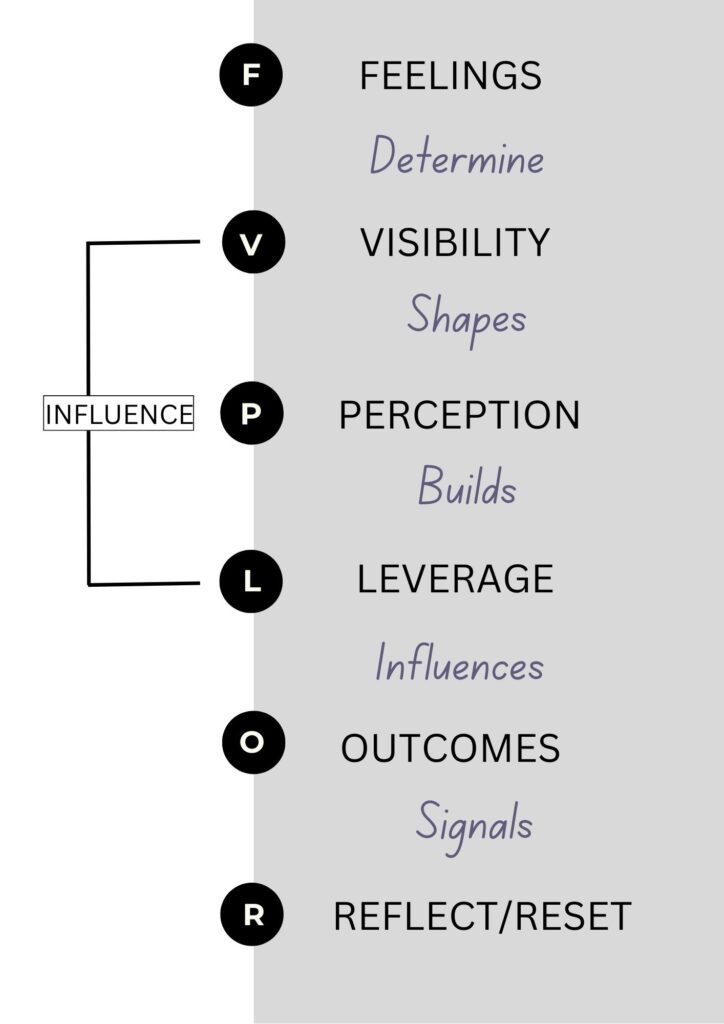
🔹 3. Perception
How others interpret what they see.
This is where reputation is shaped — not by what you do, but by how others read it. Perception governs whether you’re seen as capable, credible, promotable — or not.
____________________________________________________________________________________________________________________________________
🔹 4. Leverage
The influence you carry without needing permission.
This is what makes others act on your input, trust your judgement, or seek your involvement. Without leverage, even great work gets dismissed or quietly absorbed by others.
____________________________________________________________________________________________________________________________________
–
🔹 5. Outcomes
What works — and what doesn’t.
This is where you see the impact of your strategy. If the outcomes don’t match the effort, something earlier in the chain is misaligned.
____________________________________________________________________________________________________________________________________–
🔹 6. Reflect / Reset
The point of choice.
Every professional hits a ceiling. This phase is about diagnosing where and why, and deciding how to reset your approach before burnout or resignation takes over.
____________________________________________________________________________________________________________________________________
.
I call it the Strategic Influence Model — or the SISC Model for short.
It works like a chain- It runs on just 6 influence questions.
Each link affects the next, and if one weakens, your influence weakens.
Most professionals push from the end — Outcomes — working harder and hoping effort will fix the problem.
But influence is built further up the chain.
This model helps you spot the break — and fix it with intent.
🎯 Download the SISC Model free and start using the six questions to uncover where your influence is leaking.
🔗 [Get the Model →]
The Influence Suite — Take the Model Further
The SISC Model gives you clarity: it shows where your influence is leaking.
The Influence Suite gives you strategy: it shows how to shift it.
.
Each tool in the Suite builds on the six questions — turning awareness into smart moves you can use in real situations.
.
1. The Influence Reset
For damage control and tactical repair.
👉 If you’ve been sidelined, criticised, or undermined, we rebuild your influence chain and create a reset plan.
Example: A manager “talks too much” in a client call, loses credibility with their boss — the Reset builds a tactical repair strategy so they recover influence without more fallout.
.
2. The Future Pacer
Try on your next move before you make it.
👉 Run a tactic through the chain first — see if it builds credibility or leaks influence.
Example: Do I raise my visibility in this meeting — or will it backfire? The Future Pacer shows you the likely outcome before you act.
.
3. The Intent Decoder
Hear what they said — see what they meant.
👉 Run leadership’s words and actions through the chain to reveal true intent.
Example: A senior says “there’s room for promotion soon” but keeps delaying — the Decoder shows whether it’s a promise or a stall tactic.
.
4. The Decision Tree
Map choices forward and backward.
👉 Test a career decision through the chain to see where it leads, and what it costs.
Example: Do I stay loyal to this manager or move sideways? The Tree shows the ripple effects either way.
.
5. The Bias Decoder
Spot gender-coded language and hidden value signals.
👉 Decode performance reviews, job specs, and promotion language to see what’s really rewarded — and what’s holding you back.
Example: “Supportive” vs “Strategic” — one boxes you in, the other sets you up for growth.
.
6. The Counter Moves
Your “what should I do?” playbook.
👉 12 diagnostic angles that show how to respond when influence slips — each tied back to the chain.
Example: Gossip? Use the Allyship angle. Manager containment? Use Role Framing. Each problem has a counter move.
.
🎯 The Influence Suite is Level 2.
It’s where you stop at “why this happened” and move into “what I should do about it.”
🔗 [Explore the Influence Suite →]